Heart Failure Causes, Coronary Artery Disease (CAD)

Heart failure is caused by poor function of the heart (which is to pump blood to other parts of the body, including itself).

Common causes of heart failure include Coronary Artery Disease (CAD), hypertension, heart valve disease and a variety of other causes.

Depending on what part of the heart is involved, impaired pumping may result in fluid retention in your lungs and shortness of breath (Congestive Heart Failure or CHF), or other parts of your body (peripheral edema). When your motor doesn’t work well heart failure is also associated with a decreased ability to do things and early fatigue.

The most common cause of heart failure is CAD.

If heart failure is caused by permanent damage from previous heart attacks, increased blood supply may not help improve heart function. However, if there is impaired blood supply to an otherwise healthy heart muscle, restoring the blood flow back to normal may improve heart function significantly.

Heart failure may be the result of one or many factors. Whatever the cause, it results in the inability to supply sufficient blood flow to meet the body's needs.

Top «


The Stages of Heart Failure – NYHA Classification:
 

Class

Patient Symptoms

Class I (Mild)

No limitation of physical activity. Ordinary physical activity does not cause undue fatigue, palpitation, or dyspnea (shortness of breath).

Class II (Mild)

Slight limitation of physical activity. Comfortable at rest, but ordinary physical activity results in fatigue, palpitation, or dyspnea.

Class III (Moderate)

Marked limitation of physical activity. Comfortable at rest, but less than ordinary activity causes fatigue, palpitation, or dyspnea.

Class IV (Severe)

Unable to carry out any physical activity without discomfort. Symptoms of cardiac insufficiency at rest. If any physical activity is undertaken, discomfort is increased.


Top «

Symptoms

It is all about Fluid Congestion

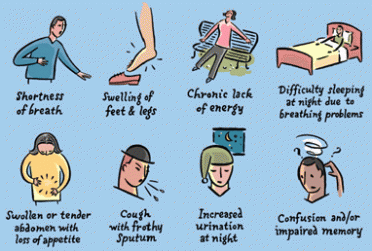
As your heart becomes less efficient as a pump it results in diminished blood flow to your body.  Your kidneys will try to compensate for it by water retention causing extra fluid build-up, which results in pooling and congestion in different parts of your body:

Pooling will cause:

  • In your lungs, shortness of breath especially when laying flat
  • Swollen Ankles or Legs
  • Weight Gain

Reduced pumping of blood to your other organs means they will not get the “energy supply” to do their work. This causes:

  • Diminished exercise capacity
  • Easy fatigue
  • Dizziness
  • Loss of appetite

Top «

Anemia

Patients with congestive heart failure (CHF) may have an associated problem of anemia, a decrease in the number of red blood cells, the component of blood that carries oxygen. Even by itself, anemia can cause symptoms of shortness of breath and fatigue, similar to the symptoms of heart failure. A low blood count limits the amount of oxygen being carried to the body, which makes the heart work harder. In fact, as the severity of CHF progresses, the findings of anemia increase; and severe anemia due to any cause can worsen CHF. Because of this relationship, anemia treatment may be an important part of CHF.

Two medications, erythropoietin and darbepoetin alfa, stimulate RBC growth and production in the bone marrow. These medicines require being given by a shot (like insulin) usually every 1-4 weeks. This can help people with heart failure correct their anemia, when it is due to inadequate bone marrow production.
In general, severe anemia may also be treated with vitamins or blood transfusions.

Top «

Heart Failure Causes

Coronary Artery Disease (CAD)

This is the most common cause of heart failure in the U.S. today. CAD causing obstruction to the coronary arteries prevents blood flow and, therefore, oxygen delivery to the heart. CAD is a manifestation of atherosclerosis, which can affect any artery of the body. Risk factors for CAD also include smoking, high cholesterol, hypertension, and diabetes.

Hypertension

This is more commonly known as high blood pressure. It is a condition that is treatable and simple to diagnose with a blood pressure cuff. Although most individuals will not have symptoms, hypertension is detected by a simple measurement with a blood pressure cuff and stethoscope. It is also a risk factor for CAD, stroke, peripheral vascular disease, or kidney impairment.

Diseased Heart Valves

A condition that occurs when the valves between the chambers of the heart are too tight or leaking.

Cardiomyopathy

A disease of the heart muscle caused by a variety of other illnesses:

  1. Diabetes
  2. Obesity and Metabolic Syndrome
  3. Alcohol, or drug abuse
  4. failure to take medications
  5. large salt intake in diet
  6. Arrhythmias

Top «

Diagnosis

Doctors usually suspect heart failure on the basis of symptoms alone. The diagnosis is supported by the results of a physical examination, including a weak, often rapid pulse, reduced blood pressure, abnormal heart sounds and fluid accumulation in the lungs (both heard through a stethoscope), an enlarged heart, swollen neck veins, an enlarged liver, and swelling in the abdomen or legs. A chest x-ray can show an enlarged heart and fluid accumulation in the lungs.

Electrocardiography (EKG) is almost always performed to determine whether the heart rhythm is normal, whether the walls of the ventricles are thickened, and whether the person has had a heart attack.

Echocardiography (ECHO), is one of the best procedures for evaluating heart function, including the pumping ability of the heart and the functioning of heart valves. Echocardiography can show the following:

  • Whether the heart walls are thickened and relax normally
  • Whether the valves are functioning normally
  • Whether contractions are normal
  • Whether any area of the heart is contracting abnormally

Echocardiography may help determine whether heart failure is due to systolic or diastolic dysfunction by enabling doctors to estimate the thickness and stiffness of the heart walls and the ejection fraction.

The ejection fraction, an important measure of heart function, is the percentage of blood pumped out by the heart with each beat. A normal left ventricle ejects about 60% of the blood in it. If the ejection fraction is low, systolic dysfunction is confirmed. If the ejection fraction is normal or high in a person who has symptoms of heart failure, diastolic dysfunction is likely.

Other procedures, such as radionuclide, magnetic resonance, or computed tomography imaging and cardiac catheterization with angiography may be done to identify the cause of heart failure. Rarely, a biopsy of heart muscle is needed, usually when doctors suspect infiltration of the heart (as occurs in amyloidosis) or myocarditis due to a bacterial, viral, or other infection.

Treatment

Drug treatment includes:

  • Diuretics to help eliminate excess fluids from the body. They cause the kidneys to make more urine and increase the body's excretion of sodium, chloride, and potassium.
  • Angiotensin Converting Enzyme (ACE) Inhibitors block the formation of Angiotensin II, a substance that causes constriction of blood vessels. In this way, ACE inhibitors reduce the strain on the heart. They relax smaller arteries and lower blood pressure. For this reason they can cause dizziness.
  • Vasodilators such as Hydralazine, Isordil, Nitroglycerin
  • Beta Blockers. Studies with the beta-blocker Carvedilol have found improved symptoms and survival in some patients. Angiotensin II Receptor Blockers (ARBs). ARBs are generally used as an alternate therapy to ACE inhibitors when ACE inhibitors cause side effects
  • Digitalis. Digitalis increases the strength of the heart's contractions as well as reducing resistance in the blood vessels of the body. It also decreases heart rate in heart failure patients and may decrease edema

Surgery

  • Treatment for coronary artery disease may include stenting or bypass surgery
  • A leaky or tight heart valve can often be repaired or replaced
  • If your heart cannot be repaired, a heart transplantation is a solution for some patients, just like
  • LVAD, left ventricular assist device, “mechanical heart”
  • Bi ventricular pacing. In some cases, the hearts will incur damage to the cells that carry signals needed for proper contraction. When this causes the signals to travel out of sync, the pumping becomes less forceful and efficient. This knowledge has spurred the development of devices for "biventricular pacing."

Since only 15 to 25% of heart failure patients will have the specific conditions that would warrant implantation of a biventricular pacer, this resynchronization device will not replace most standard heart failure treatments and medications.

Top «

The Automatic Implantable Cardioverter-Defibrillator (AICD) is a device intended to convert life threatening rhythms that may cause sudden cardiac death, to a sinus (normal) rhythm:


Top «

Heart Failure Clinics

Symptoms of heart failure are potentially recurrent and disabling. Almost half of heart failure patients 70 years or older admitted to the hospital will require repeat hospital admission within 90 days. Heart Failure Clinics have been created to reduce the disability associated with chronic heart failure and help patients to be active partners in their care can improve symptoms and possibly long term outcome.

Top «